RTP
96.00%
MegaBlock
RTP:
96.00%

MegaBlockAbout the game
Game Attributes
MegaBlock Game Review
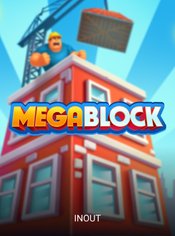
96% is the return on MegaBlock, and it is the least interesting number on the screen. InOut Games put this one out in February 2026 and built it around a childhood arcade memory: a block swings back and forth above a tower, you drop it, and if it lands off-centre the overhang is sheared away so the next floor sits on a narrower base. Every clean floor pushes the multiplier higher. Cash out whenever you like, or keep building. The MegaBlock game has no reels, no paylines and no bonus round, only a tower and your nerve.
Theme & Presentation
There is almost nothing on screen, and that is the design. A dark background, a growing stack of coloured slabs, a counter above them, one button. No mascot, no story, no cutscene between rounds. The look is borrowed wholesale from those tower-stacking games that used to sit on phone home screens, and InOut has resisted the usual urge to bolt a casino theme on top of it.
What the presentation does carry is tension, and it carries it through motion rather than art. Floors swing wider and faster at the higher risk settings, so difficulty becomes something you watch instead of something you read in a menu. Sound follows the same logic: a clean click on a perfect drop, a duller thud when half a block shears off. Much of the rest of the InOut games catalogue works this way, stripping an instant format down to a single gesture and a single decision.
RTP & Risk Levels
| Spec | Value | Note |
| Format | Single-player tower stack | No shared round timer, you set the pace |
| Risk levels | Low, medium, high | Chosen before the round begins |
| Block behaviour | Floors swing above the tower | Overhang is trimmed off after an imperfect drop |
| Multiplier | Climbs floor by floor, in real time | Locked at the value showing when you stop |
| Cash-out | Manual, at any height | Available at every point in the round |
| Platform | Browser, desktop and mobile | Nothing to install |
Three risk settings wait in front of the round: low, medium and high. Low gives you wide blocks and a lazy swing, and the multiplier creeps upward accordingly. High narrows the blocks, speeds the swing until the timing window starts to feel unreasonable, and compensates with a far steeper climb per floor. Medium lands where you would expect.
What the setting really changes is the shape of a session. Low risk turns MegaBlock into a grind of small, frequent cash-outs. High risk turns it into a handful of short, sharp attempts at something large. Neither of those is a strategy so much as a temperament. AviaFly 2 makes a comparable trade by swapping the genre's usual straight climb for an actual flight path.
How a Round Plays
You stake, you pick a risk level, the first floor appears. From there the loop is one button. A block slides left and right above the stack; press, and it falls. Land it clean and the whole block stays. Land it off-centre and the overhang shears away, leaving less surface for the next drop and making the following floor harder than the one before it. That compounding is the real mechanic, and it is what separates this from a pure crash game. A sloppy third floor can quietly ruin a run that still looks healthy at floor eight.
MegaBlock runs as a single-player round, which matters more than it first sounds. Crash formats that share one multiplier across an entire lobby put you on somebody else's clock. Here the tower waits, and every pause belongs to you. The multiplier updates live above the stack and cashing out is available at any height. Miss the stack entirely and the round ends with nothing: no partial payout, no safety net, no second chance built into the format. Instant titles such as the Chicken Road 2.0 demo run the same all-or-nothing arithmetic with a road instead of a tower.
The InOut Instant Line-Up
Below are the other instant games InOut has on our platform, listed with the moment each one takes the decision out of your hands.
| Game | Format | What ends the round |
| MegaBlock | Tower stacking | A missed drop, or your cash-out |
| Tower | Climbing floors | A wrong pick, or your cash-out |
| Goblin Tower | Climbing floors | A wrong pick, or your cash-out |
| Crash | Rising multiplier | The crash, or your cash-out |
| Limbo | Target multiplier | One result checked against the target you set |
| Mines | Grid reveal | A mine, or your cash-out |
| Hot Mines | Grid reveal | A mine, or your cash-out |
| Hilo | Card call | A wrong higher or lower call, or your cash-out |
| Plinko Aztec | Ball drop | Wherever the ball settles |
| Coinflip | Coin toss | The flip itself |
Reading down that list, the oddity of MegaBlock becomes obvious. Most instant formats hand you a fixed decision tree: pick a tile, call a card, set a number in advance. This one asks for physical timing instead, which puts it closer to a reflex game than to anything else in the catalogue. Whether that counts as an advantage depends entirely on how steady your hands are at two in the morning. It also means the learning curve here is real. A tile-picking game plays identically on your first round and your thousandth. This one does not, and the gap between a newcomer and somebody who has internalised the swing speed at high risk is wide enough to show up in the results.
How to Play
Pick a stake, pick a risk level, drop the first block. Everything after that is one button and one judgement call, repeated until you either bank the multiplier or miss. Two habits genuinely help. Decide the floor you intend to stop at before you begin, because deciding mid-climb almost never ends well. And treat the first few rounds at any new risk level as calibration rather than as bets, since the swing speed changes more than the menu lets on. A third habit costs nothing at all: change one variable at a time. Moving the stake and the risk level together leaves you no way of telling which of them produced the result.
The demo runs the same round logic as real play, so the timing is cheap to learn. Once it clicks, MegaBlock is sitting in our instant section ready for a real stake, next to the Ballonix demo if you want another hold-and-release format to measure it against.