RTP
96.51%
Reactoonz
RTP:
96.51%

ReactoonzAbout the game
Game Attributes
Reactoonz Slot Review
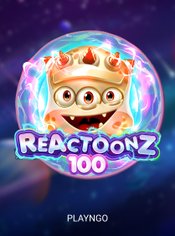
Reactoonz is a game about small aliens being destroyed at scale. Play'n GO hung a 7x7 grid in deep space, filled it with one-eyed and two-eyed creatures that blink, giggle and panic at the player, then built a machine for clearing them out in waves. The Reactoonz slot arrived in October 2017 and still pulls more play than most of this year's releases. There is no free spins round. There are no paylines either. What the game runs on instead: a charging meter down one side, a three-eyed monster waiting in a glass tank on the other, and a 4,570x cap over the whole thing.
Theme, Graphics & Sound
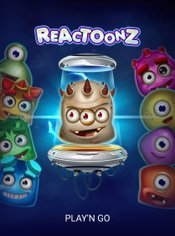
The aliens are the entire personality of this game, and Play'n GO knew it. Each one has its own idle animation, its own reaction to being cleared, and its own noise. They wobble. They look nervous. When a cascade chain runs long they start visibly panicking, which is the sort of detail that separates a grid slot people remember from one they close after ten spins. Gargantoon, the three-eyed one, sits in his tank at the edge of the screen and gets angrier as the meter fills.
Sound does more work here than in most slots of its era. A rising hum tracks the charge level, so your ears register that something is coming before your eyes do. The studio had already tested this look four years earlier: the Energoonz slot from 2013 used the same drop-and-clear idea with a cruder cast, and Play'n GO still calls it this game's prequel.
RTP, Volatility & The Quantum Meter
| Spec | Value | Note |
| Release | 23 October 2017 | Play'n GO's breakthrough grid slot |
| Quantum meter charge | 25 symbols | One Quantum feature queued per charge |
| Quantum features | 4 | Implosion, Alteration, Demolition, Incision |
| Gargantoon trigger | Fifth charge | Lands as a 3x3 wild, then splits twice |
| Random wilds | 4 to 8 | Dropped on spins that produce nothing |
| Free spins round | None | Every feature fires in the base game |
Of every number attached to this game, 96.51% is the least dramatic and the most useful: a return sitting a shade above the rough industry average, paired with volatility at the top of the scale. That combination is harder to build than it sounds, because high variance normally pays for its swings by shaving the return. Here the swings come out of feature stacking instead.
High volatility usually implies a free spins round doing the heavy lifting. There is none here, so the whole distribution rides on the base game: long flat stretches, then a spin where four queued features fire in sequence and the balance moves by a factor nobody saw coming. Fifty spins tell you almost nothing about this game.
The meter explains why. Every symbol that forms part of a win charges it, and each full charge drops one Quantum feature into a queue. The round does not finish when the cascades stop. It finishes when the queue is empty and no further wins appear, which is why a single spin can run for the better part of a minute and why a board that looks dead usually is not.
Symbols & Payouts
| Symbol | Type | 15-plus cluster pay |
| Purple two-eyed alien | Top premium | 750x |
| Green two-eyed alien | Premium | 300x |
| Orange two-eyed alien | Premium | 150x |
| Blue two-eyed alien | Premium | 75x |
| Red and purple one-eyed | Low pay | 10x |
| Yellow and green one-eyed | Low pay | 3x |
| Wild | Substitute | Stands in for every alien |
Wins need five or more matching aliens touching horizontally or vertically, and a cluster counts up to 15 symbols. Two-eyed aliens are the ones with real money behind them. The purple one pays 750x the stake on a 15-plus cluster, which is the point where the ceiling starts to look reachable rather than theoretical.
One-eyed aliens exist mostly as fuel. They pay almost nothing, they clutter the board, and they charge the meter, which is why Demolition, the feature that wipes every one of them at once, is quietly one of the best outcomes available. There is also a merge rule worth knowing: four matching aliens sitting in a 2x2 square combine into a single oversized alien, and that oversized version multiplies the prize when it lands inside a winning cluster.
Cascades do the rest. Every alien in a winning cluster is teleported off the board, new ones drop into the gaps, and the process repeats for as long as fresh clusters keep forming. A single spin can resolve four or five times before it settles, and each of those resolutions feeds the meter. The loop is the entire design, and it is the reason the game rarely feels static even during a cold run.
Reactoonz Bonus Features
Quantum Leap Features
Collecting 25 symbols adds one of four features to the queue. Implosion converts three to six symbols into wilds and destroys what sits next to them. Incision cuts a wild into the centre and draws two diagonal lines of one repeated symbol. Demolition clears every one-eyed alien off the board. Alteration picks one low-value alien and turns every copy of it into a different symbol. Four can sit in the queue at once.
Gargantoon
Charge a fifth time and Gargantoon gets appended to the end of that queue. He lands as a 3x3 wild, splits into two 2x2 wilds on the next cascade, then breaks into nine single wilds after that. Almost every big-win clip from this game is a Gargantoon sequence. He also keeps a consolation habit: on a spin that produces nothing at all, he may drop four to eight wilds onto the grid unprompted.
Buy Feature
A buy option sits on the page. Given how readily the base game charges its own meter, this is close to the least necessary purchase in the studio's catalogue, and the charge rate in the paragraphs above is the reason.
How to Play
Bets sit anywhere between $0.20 and $100, and after that the game plays itself. Clusters evaluate automatically, cascades resolve without input, and the queue empties in its own time. Watch the meter rather than the balance for your first hundred spins, because the meter is what tells you whether a round is going anywhere. It reads cleanly on phones too, which matters for a 7x7 board that could easily have turned into mush at that size. For a completely different Play'n GO shape, Triple Launch Fortune Wild is one of the studio's more recent additions to our platform.
The Reactoonz Line-Up
Six games carry this cast on our platform, and they do not all play the same way. One of them is not even a cluster slot any more. The numbers below show what each sequel actually changed, which is more useful than the release order suggests, because the newest entry is the one that walked away from the mechanic that made the name.
| Game | RTP | Max win | Engine |
| Reactoonz 2 | 96.20% | 5,083x | Adds the Fluctometer and Electric Wilds |
| Reactoonz 100 | 96.20% | 10,000x | Same cluster grid, far higher ceiling |
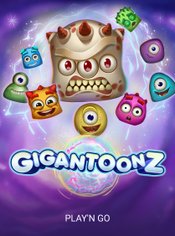
| Gigantoonz | 96.25% | n/a | Mega symbols on a four-level Quantumeter |
| Dr Toonz | 96.25% | n/a | Spin-off built around the series' scientist |
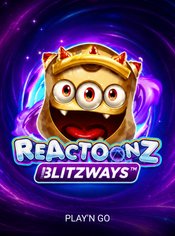
| Reactoonz Blitzways | 96.20% | 10,000x | Five reels, up to 16,807 Blitzways, no clusters |
One pattern jumps out of that column: every follow-up returns less than the 2017 original, and the two newest carry ceilings more than double it. Bigger caps look better on a game tile. They usually also mean longer gaps between the moments worth watching, which is a trade the original never had to make.
Our Take
Nine years on, this still sets the bar for what a grid slot should feel like. The meter turns losing spins into progress, the queue makes the end of a round genuinely uncertain, and Gargantoon is one of the few signature features in the format that players can name without prompting. The catch is real: high volatility with no free spins round means a short session can be both brutal and boring. Open the free demo here first, and if the board feels like too much happening at once, Reactoonz Blitzways in the table above runs the same aliens across five reels instead.